Gauged before it is cut

Leather Race Suit Construction: What Happens Between a Hide and a Suit

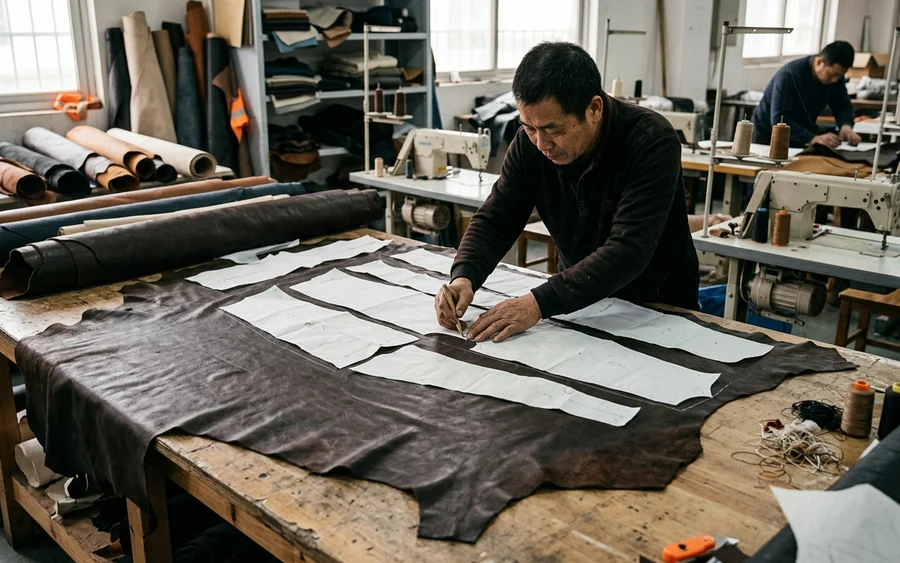
Specification held per panel area 1.1–1.3MM Cowhide, gauged on every hide before a single panel is cut — not taken from the label on the bundle.
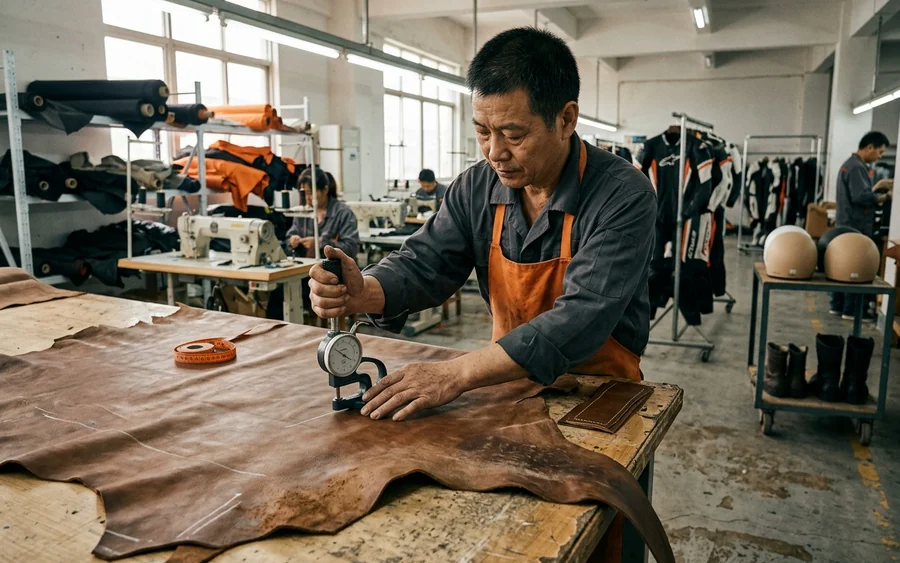
A hide being gauged with a thickness meter before anything is cut01Gauge
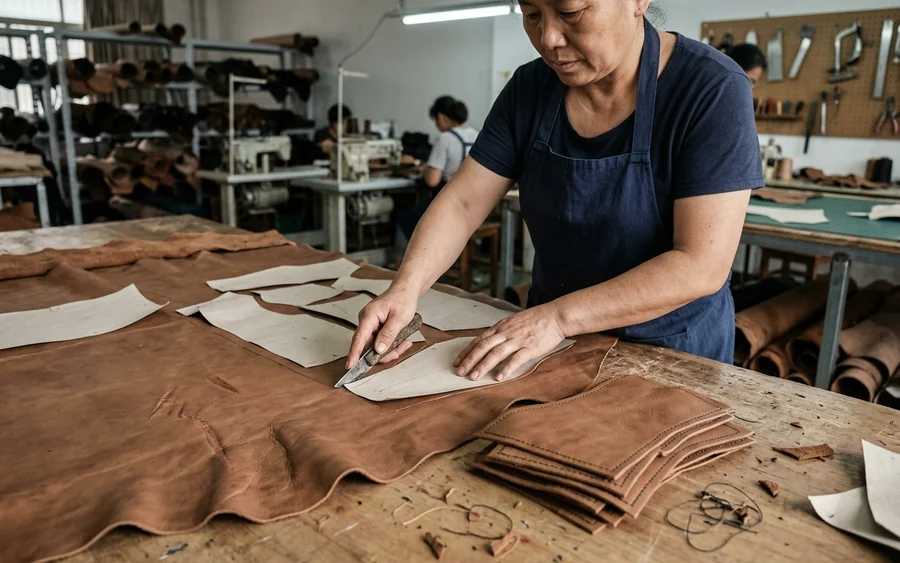
Pattern panels laid on the hide in their correct stretch direction02Place
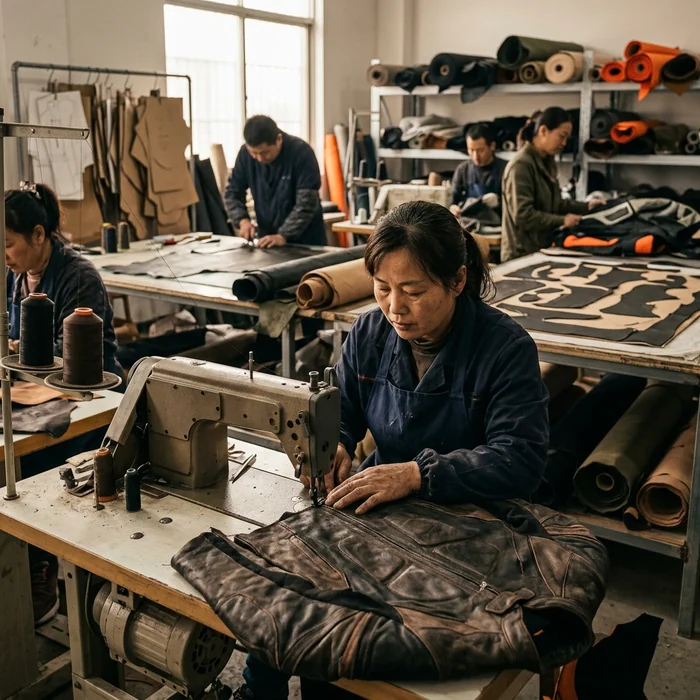
Panels cut around scars and grain variation03Cut
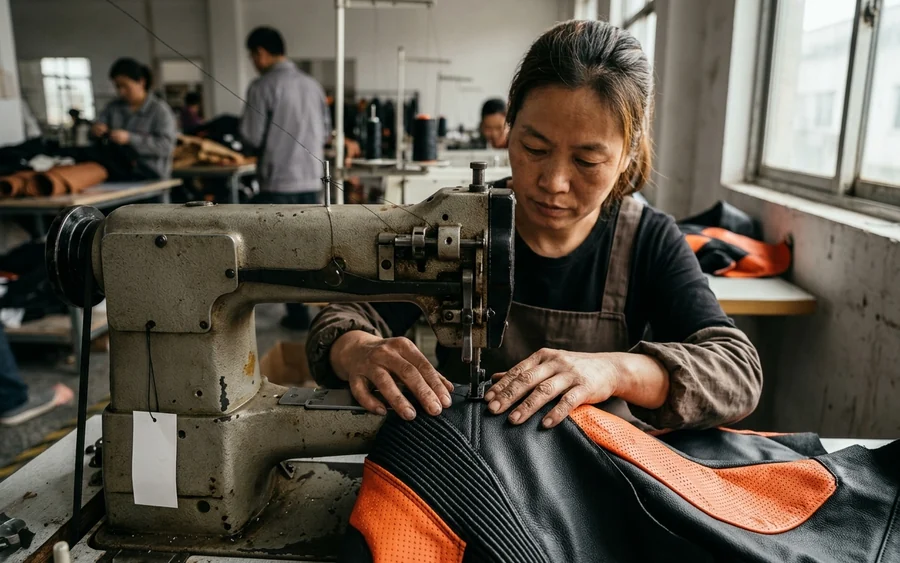
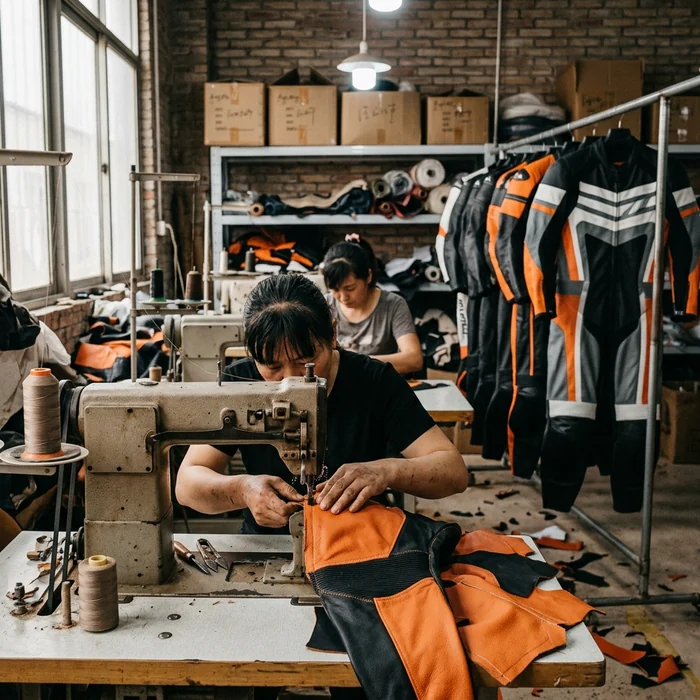
A slide-zone seam being run twin-needle on the leather machine04Seam
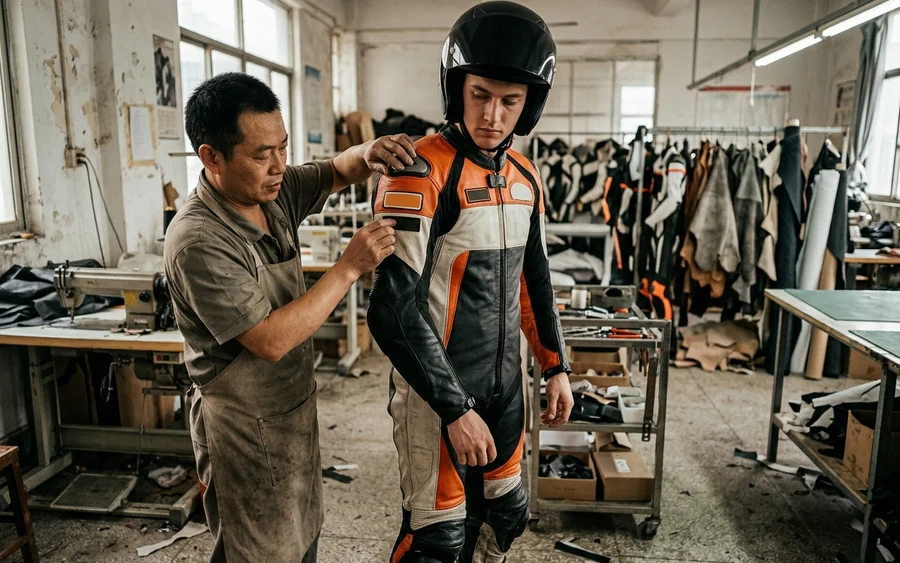
The finished suit being fitted on the rider with the armor in05Fit

A leather race suit is the one garment here where a mistake cannot be unpicked. Every needle hole in a hide is permanent, every panel has a direction it wants to stretch, and no two hides off the same rack are the same thickness end to end. This page is the leather workshop.

Who reads this page

Who reads this page: riders, teams, clubs and brands ordering leathers

Four readers about to spend real money on a garment that has to fit one body and survive one bad day.

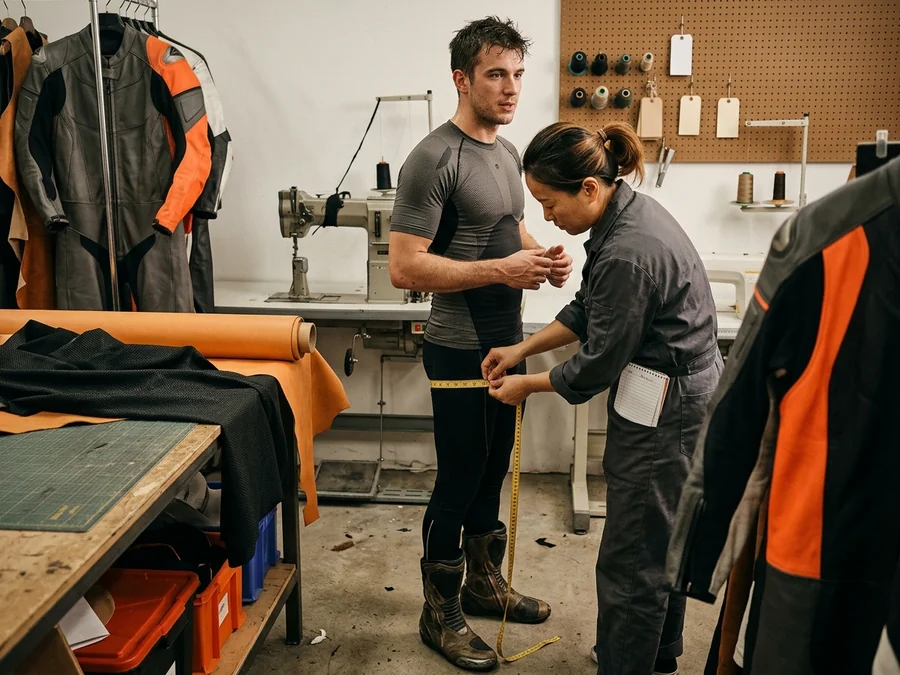
Track-day rider being measured for a made-to-measure suit

Racers and track-day riders

Order one suit, made to their measurements, and want to know exactly what they are paying for.

Wants · what the money buys
Team manager checking several suits that have to match each other

Team managers

Order several in a season and need them to match each other — and to survive a crash.
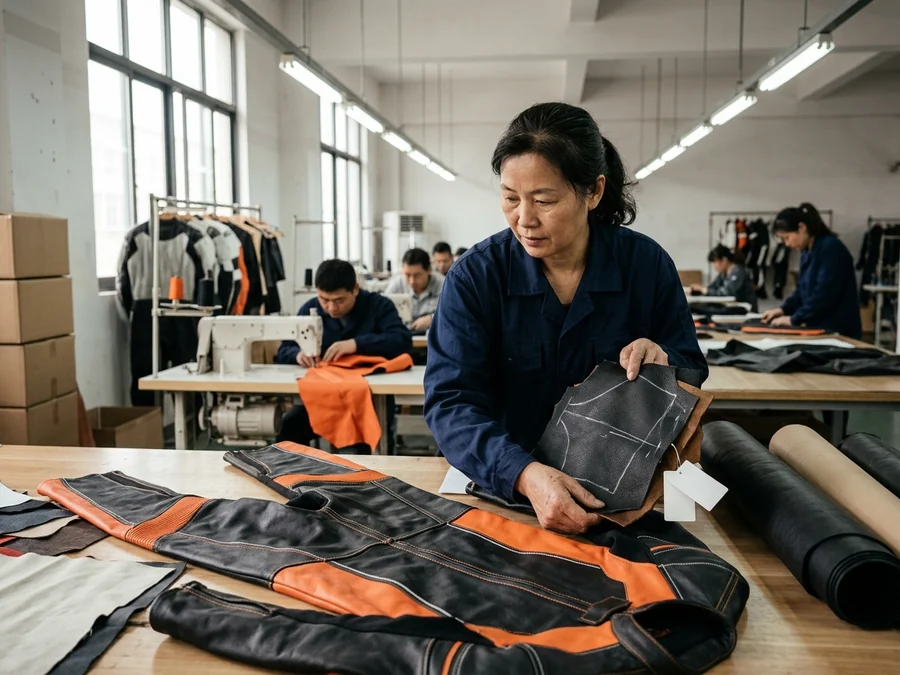
Wants · consistency across riders
Brand product manager reviewing a leather line specification

Riding-gear brands

Build a leather line and need to know what is decided at the hide and what is decided at the pattern.
Wants · the decision points
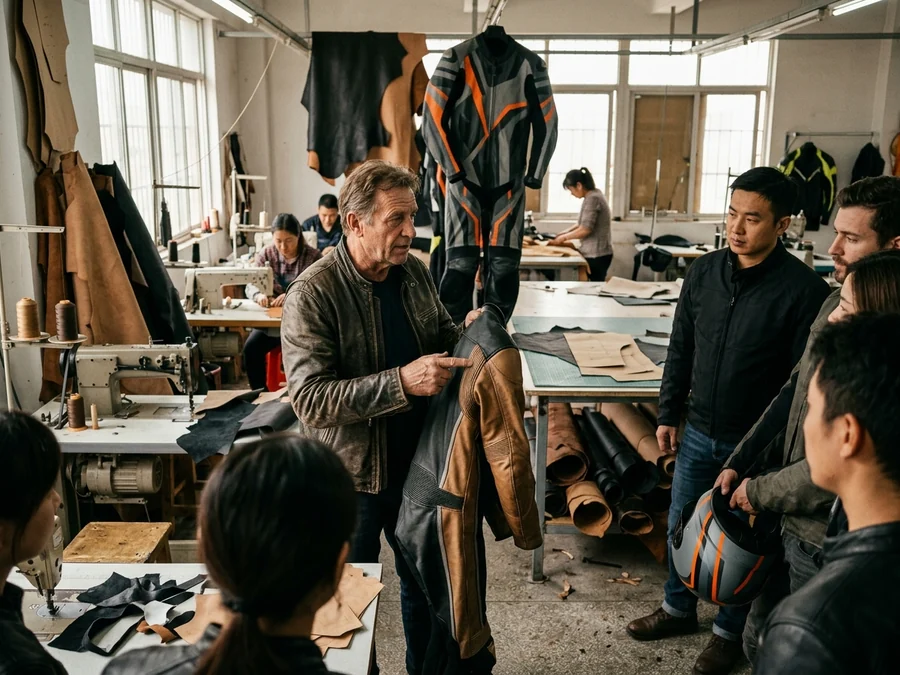
Academy instructor in leathers explaining construction to members

Clubs and academies

Buy leathers for instructors and want construction they can explain to their own members.

Wants · something to explain
Not this page
  • The fit and the block, which sit in pattern making
  • Textile and laminate jackets, built a different way
The raw material

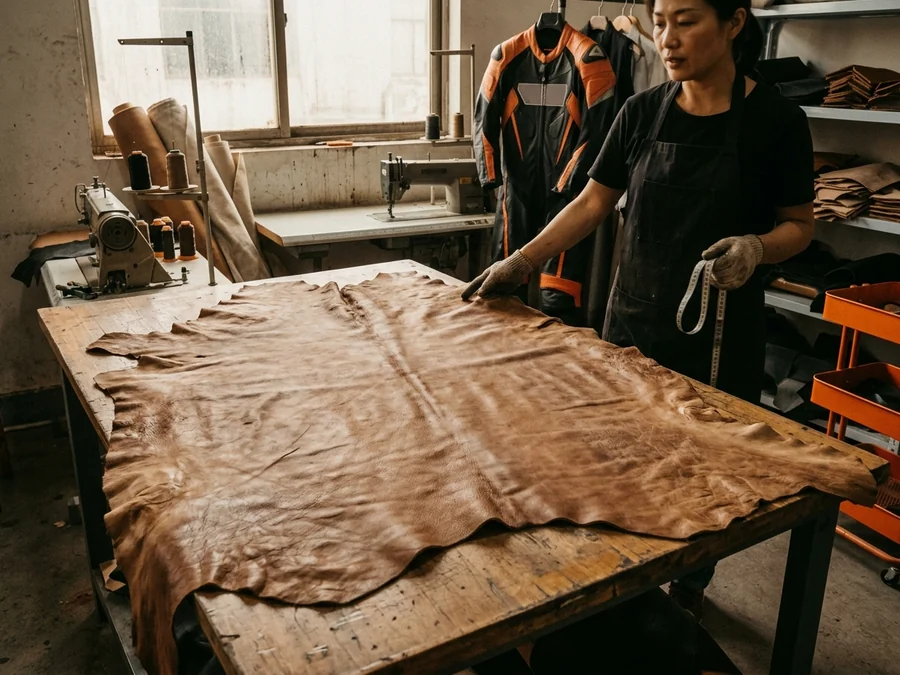
A hide is not a roll of fabric

Leather is a material with a history, and the suit is built around what that history did to it. Three things get looked at on every hide.
A full hide showing the difference between back, belly and neck areas
01

The hide has zones

Dense at the back · loose at the belly

The fibre is tight along the backbone and looser towards the belly. A belly panel on a shoulder is a cheaper suit, and that is exactly why it is there.
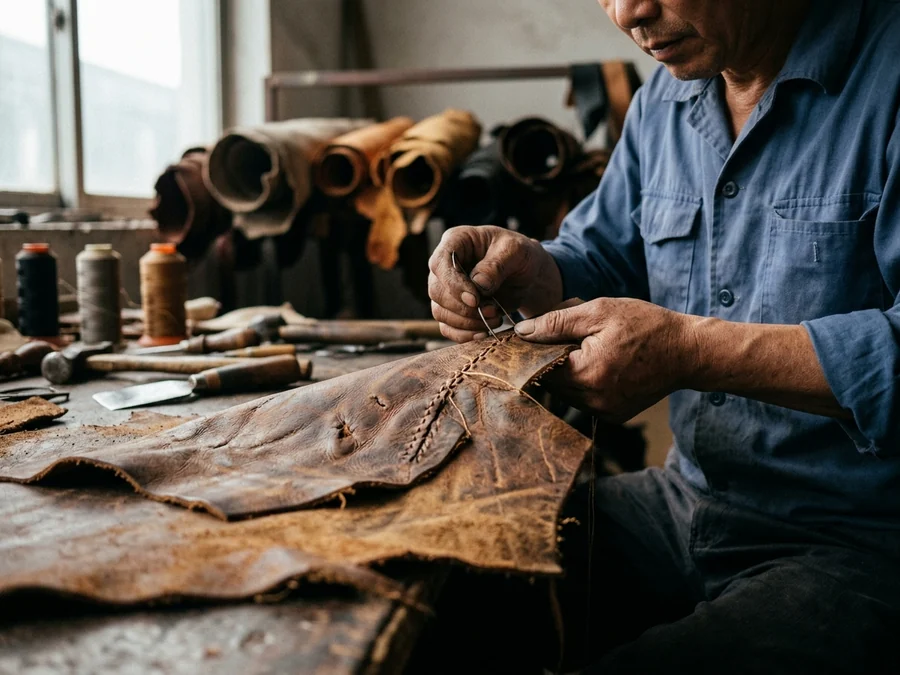
Scars, brand marks and grain variation on a hide
02

The hide has defects

Worked around · not hidden

Scars, brand marks, insect damage and grain variation. They are mapped before cutting so they land in offcuts, not on a knee.
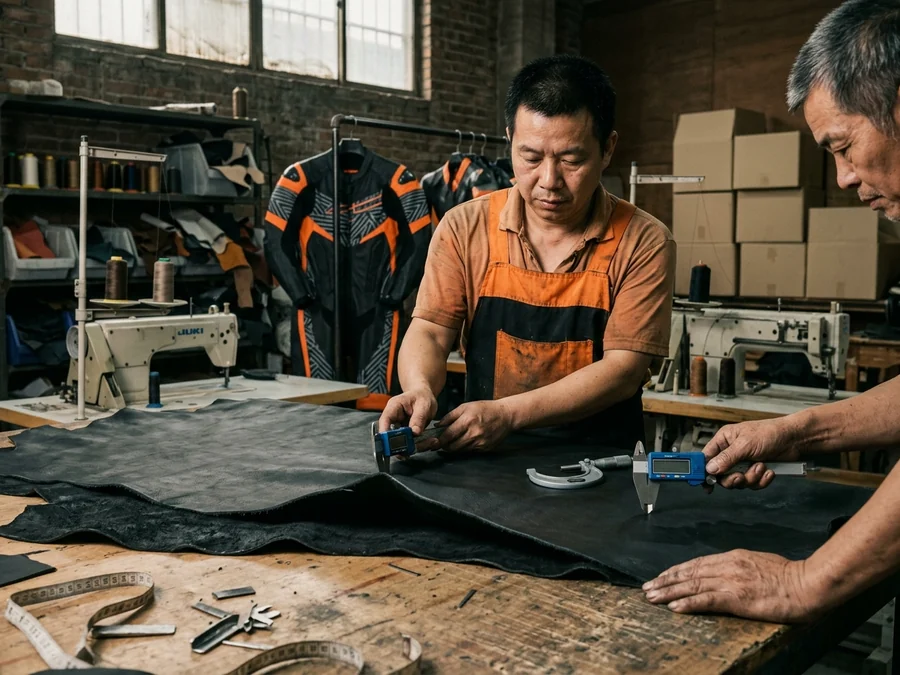
The same hide measuring thicker in the middle than at the edges
03

The hide varies in thickness

Middle thick · edges thin

Thicker in the middle than at the edges, which is why a bundle labelled 1.2 mm still has to be measured panel area by panel area.

Yield is the tellA suit built by nesting pattern pieces for maximum yield puts a belly panel on a shoulder and a scar on a knee. Ask where the shoulder and back panels came off the hide — a factory that cuts for yield will not have an answer.
Gauging

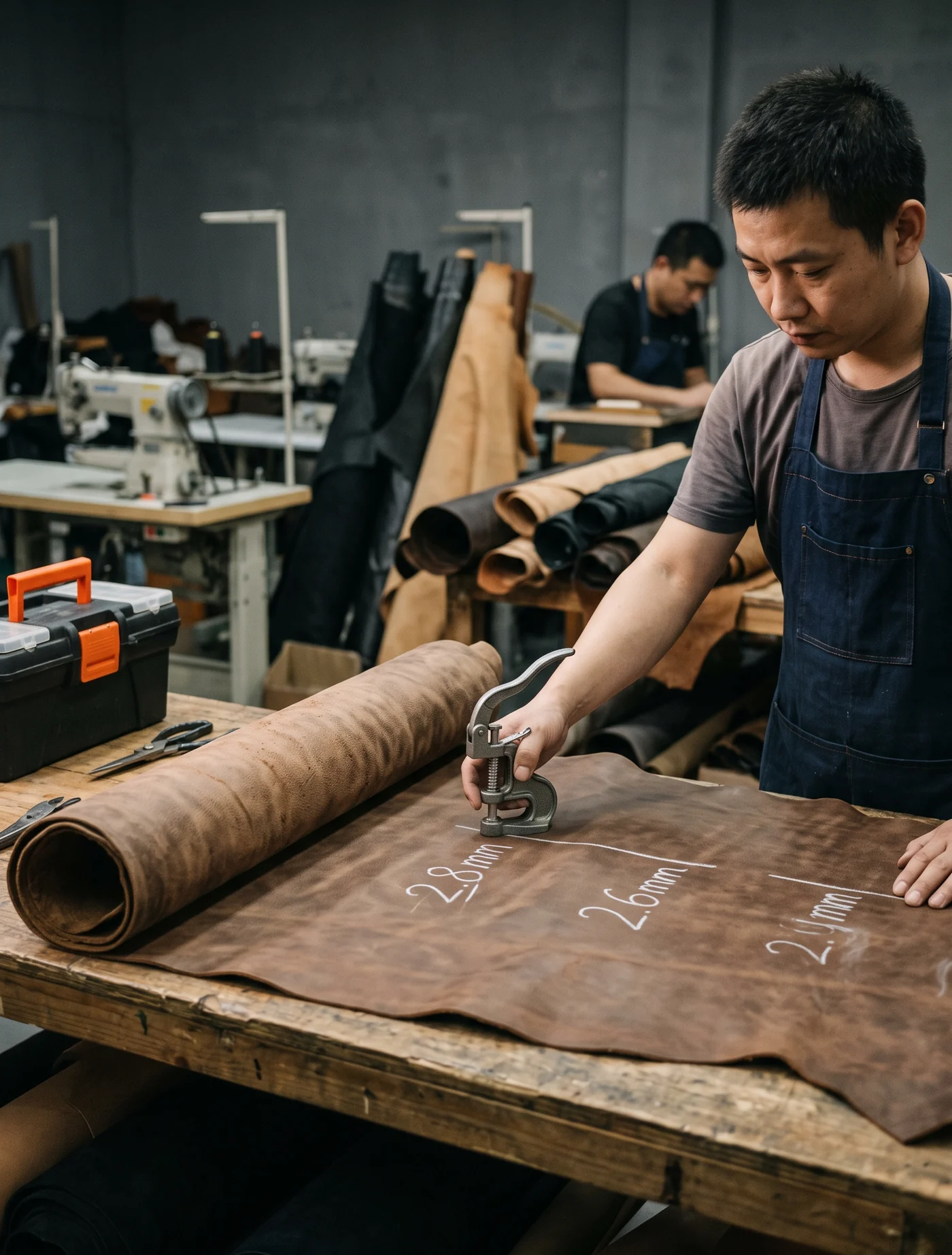
Gauging: every hide measured before anything is cut

1.1–1.3 mm is the specification, and the only way to hold it is to measure the hide rather than trust the label

1.1–1.3MM COWHIDE

Measured at the points the main panels will come from — not once per bundle.

What the chalk marks record

  • A reading at each point a main panel will be cut from, not one reading per bundle.
  • Which panels that hide has been assigned to, so the cutter is not deciding it again at the table.

The readings are chalked on the hide itself. Hides that fall outside the range in the panel areas are set aside for pieces where thickness matters less, or sent back. A hide that gauges 1.0 mm at the shoulder does not become a shoulder, regardless of what the label on the bundle says.
Why a tenth of a millimetre mattersIn a slide, the panel that meets the surface first has to last longest. At the shoulder, a tenth is the difference between a suit that scuffs and one that opens.
Thickness meter on a hide with the readings chalked beside it
Measured · and written on the hide
Placement

Placing panels on the hide: direction before yield

Leather stretches more across the backbone than along it. Each panel is laid in its correct orientation first, and the yield is whatever is left over.

PanelComes offPlaced wrong and…
Shoulder and outer armThe back, thickest areaScuffs through where the slide starts.
KneeDense back, stretch along the bendBags out after a few hours and never comes back.
Seat and inner thighEven, medium-density areaWears shiny and thin where the rider moves on the bike.
Back panelAlong the backboneStretches across the shoulders under a tuck.
Collar, cuffs, small piecesBelly and neck areasNothing — this is where those areas belong.
How to check itAsk what happens to the offcuts. A workshop that cuts for direction generates offcuts and knows exactly how many.
Permanent
from the first hole

Every needle hole in a hide stays there. Nothing in a leather suit can be unpicked and tried again.

Slide-zone seams

The seams in the slide zones: why the stitching is hidden

A seam that meets the road is a seam that comes undone. Scroll: the panels close, the twin stitch lands, and the load path draws itself.
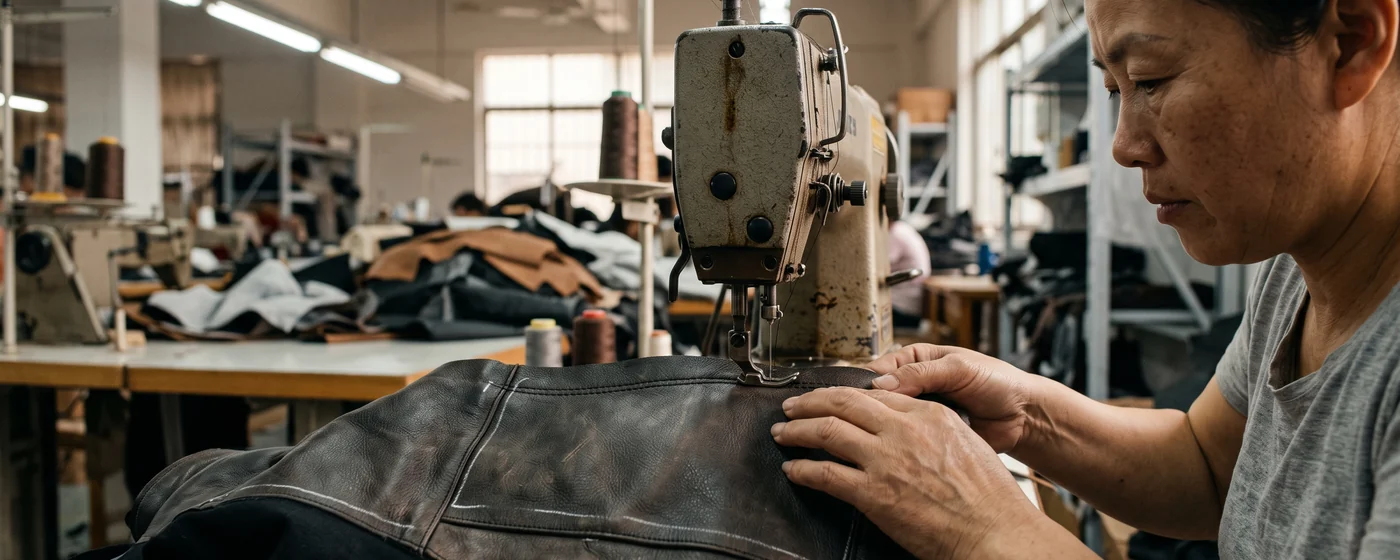
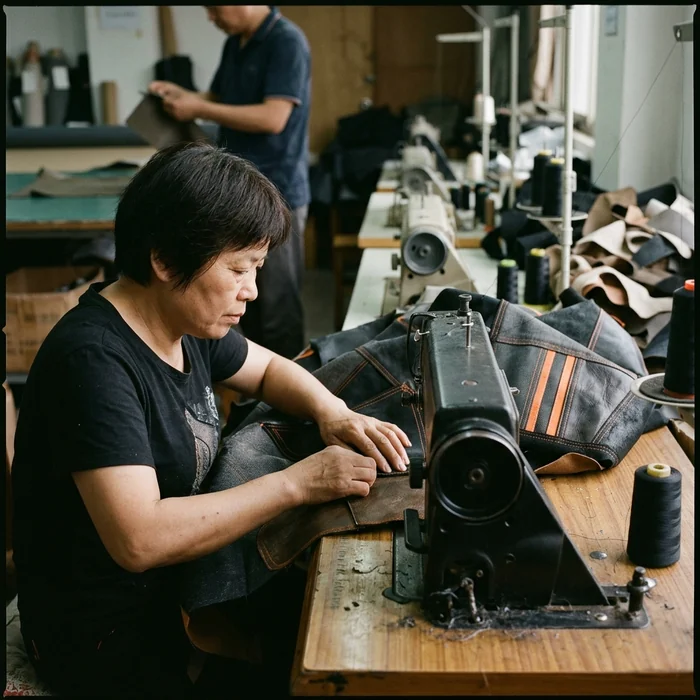
A slide-zone seam being run twin-needle on the heavy leather machine
Twin needle · slide-zone seam

Built into the structure, not sitting on top of it

In the panels most likely to contact the surface, the seams are constructed so the thread does not sit proud on the outside: the panels are joined, folded and stitched so the stitch line is protected by the leather, and the assembly is run with twin needles so a single thread failure does not open the seam. Stress points at the ends of a seam are bar-tacked.

  • Bonded nylon thread in the weight the seam needs — not the weight that runs fastest through the machine.
  • Heavier thread and a shorter stitch length in the slide zones, because more stitches per centimetre means more places the load can go.
  • Bar-tacks where a seam ends, which is where a seam starts to fail.
How to check itLook at the outside of a shoulder seam on the sample. You should see very little thread.
Not every seam is built this wayA seam that will never meet the road — an inside lining join, a pocket bag — is built for comfort and weight instead. Building every seam like a slide-zone seam makes a stiff suit; building none of them that way makes a suit that opens.
FoldedThe stitch line is protected by the leather itself, not sitting proud on the outside
Twin needleOne thread failing does not open the seam — the second row is still holding
Load pathBar-tacked where the seam ends, which is where a seam starts to fail
Stretch panels

Stretch panels: where the suit is allowed to move

Leather does not stretch where a rider needs it to, so the movement is put where it can be controlled — and the panels around it are then cut closer.
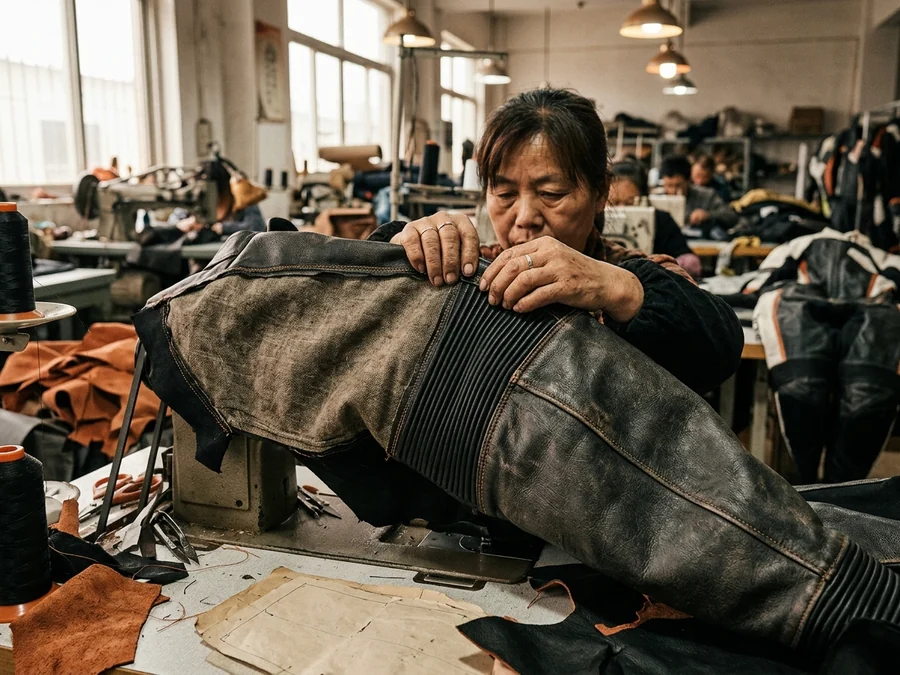
Accordion stretch panel on the inner arm of a leather suit

Inner arm

So the arms reach the bars

Accordion or stretch panel, so reaching forward does not pull the whole back tight across the shoulders.
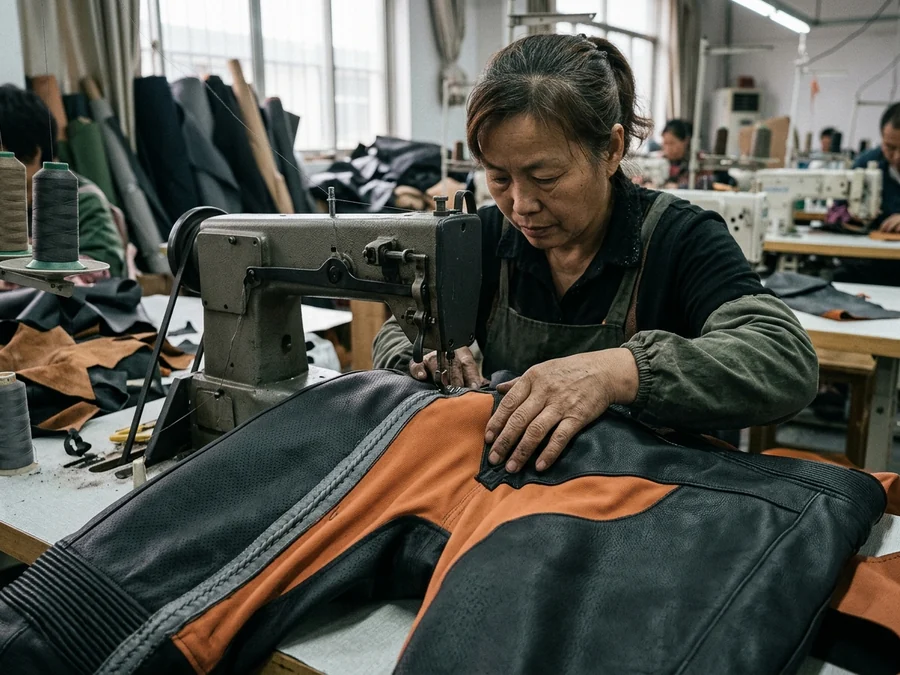
Stretch panel at the crotch and inner thigh of a race suit

Crotch and inner thigh

So the rider can move on the bike

The rider moves constantly against the tank and the seat. Without stretch here the suit fights every one of those movements.
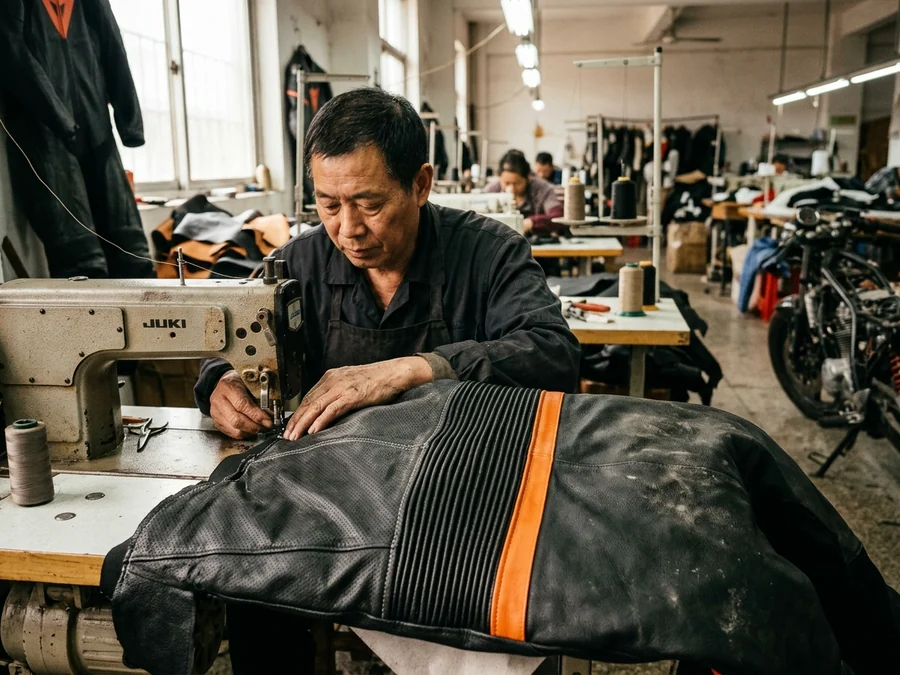
Accordion panel across the lumbar of a leather suit

Lumbar and lower back

Opens in a tuck, closes sitting up

An accordion panel that opens as the rider tucks and closes again when they sit up, instead of the hem climbing.
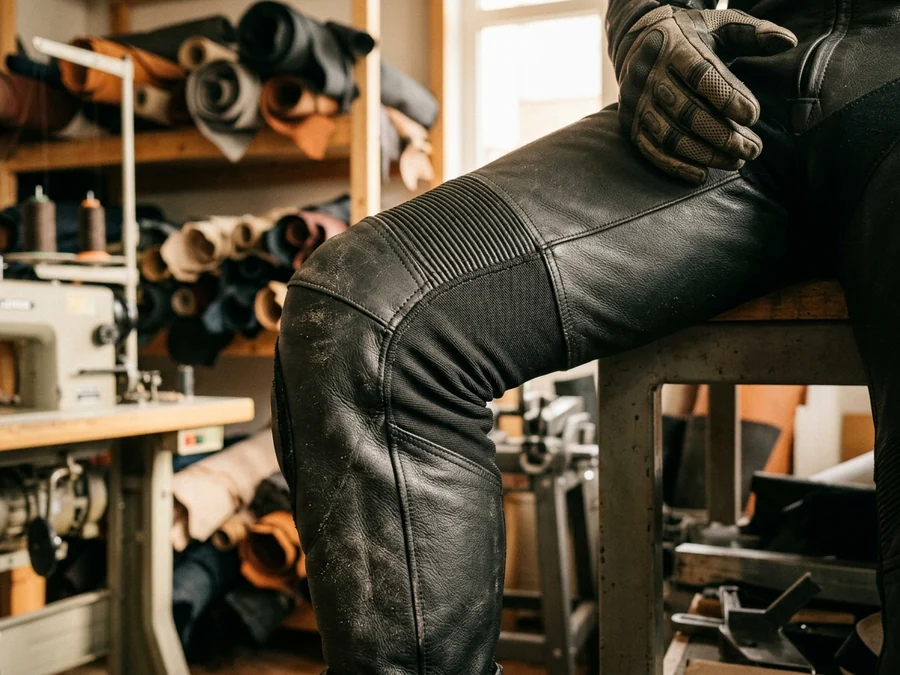
Stretch panel behind the knee of a leather suit

Behind the knee

So the leg bends fully

The leg bends for the whole ride. Stretch behind it stops the front of the knee panel from pulling down the shin.

1.1–1.3MM GAUGEDMeasured per hide, per panel area
1PIECE MINIMUMMade to measure, from one suit
15–20DAYS SAMPLESelection, pattern, cut, assembly, fitting
25–35DAYS BULKAfter sample approval
Armor and sliders

Armor pockets and where the protection sits

Pockets are positioned on the block in the riding position, and the suit is built around them

Shoulder, elbow, knee and back pockets are set on the pattern so the pad stays over the joint through the full range of movement, with the seams around them routed so no seam crosses a pad. The suit is built to take CE-rated armor in those pockets.
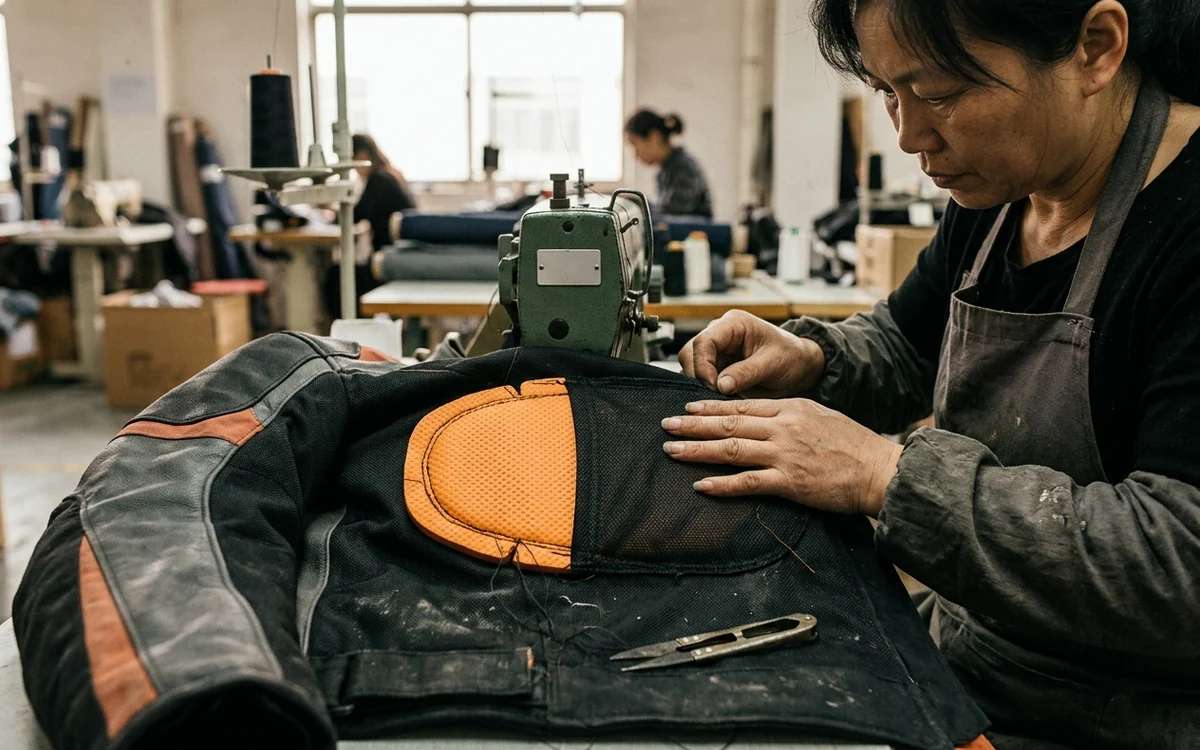
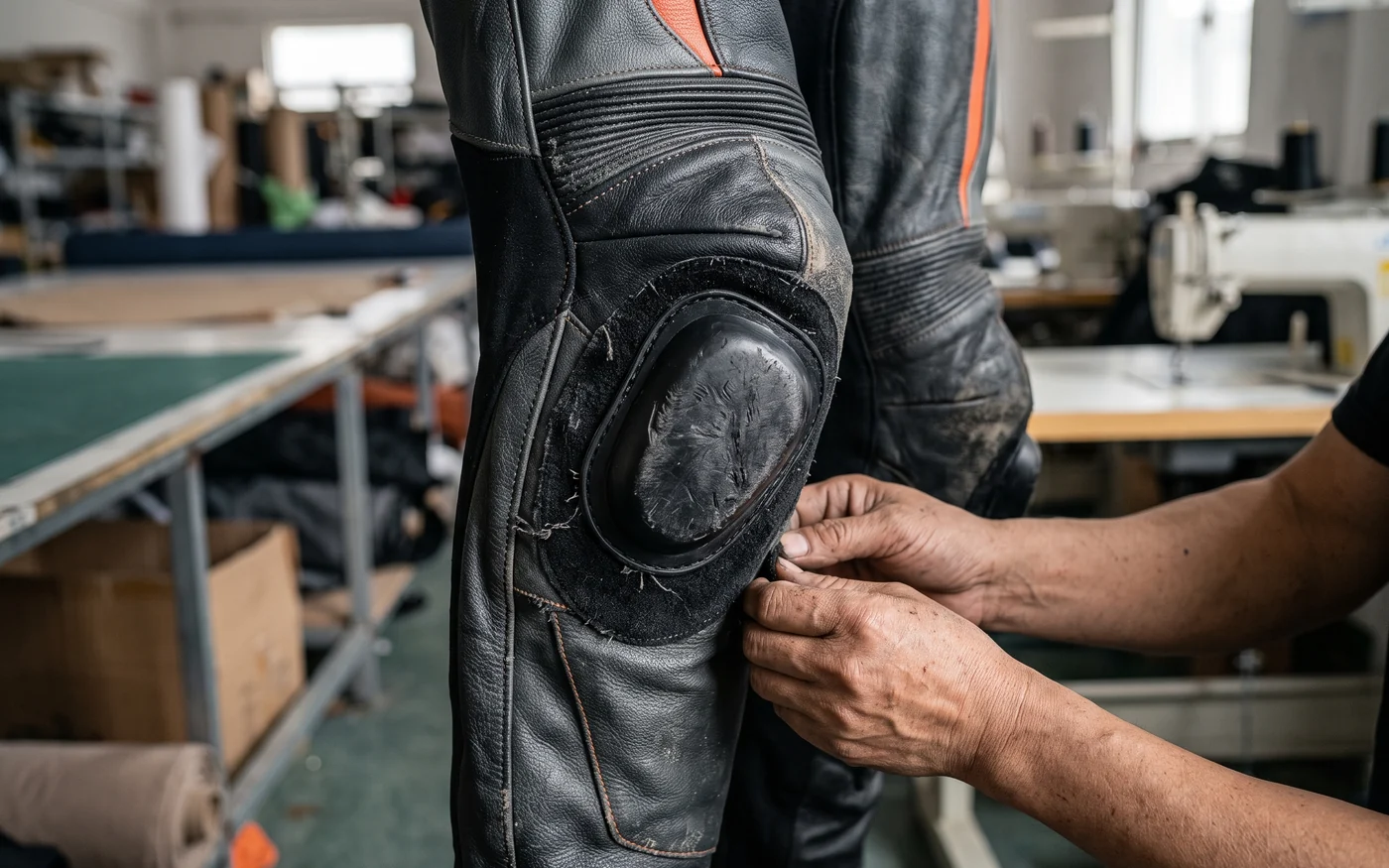
  • You or your team choose the armor itself — we build the pocket for it and we do not certify it.
  • Knee sliders, and shoulder sliders where the suit has them, are mounted on reinforced areas.
  • A slider is a deliberate wear part, so the panel beneath it has to survive being ground down.
How to check itPut the armor in and get into a tuck. The pad should be over the joint, not beside it.
Armor pocket with the seams routed around it so nothing crosses the pad
Seams routed around the pad
Knee slider mounted on a reinforced panel of a leather suit
Slider · a deliberate wear part
Made to measure

Made to measure: the measurement set and what happens with it

A race suit is cut to one body, so the set is longer than a size chart

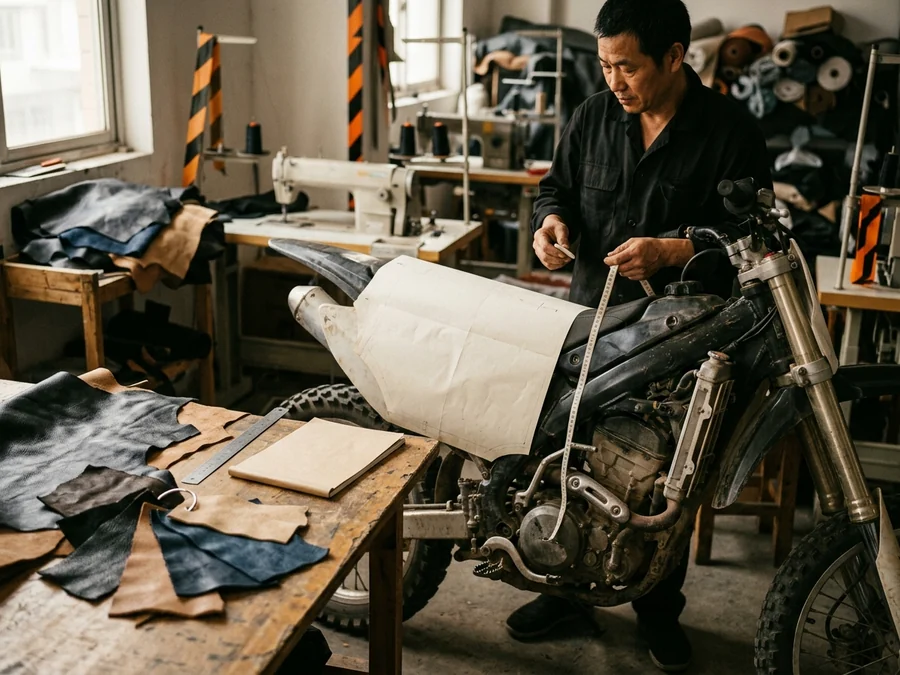
Height & weightthe starting pair Chest / waist / hipsover riding kit Inseam & outseamwith boots on Thigh / knee / calffor the leg taper Arm, bentnot straight down Bicep & wristfor the sleeve Neck & shoulderfor the collar Back length, in positionnot standing

The set goes onto the block for the discipline, and the pattern is adjusted per measurement before the first cut. Back length and arm length are taken with the rider in a riding position — a back length measured standing produces a suit that rides up, which is the most common complaint about a suit that was "measured correctly".
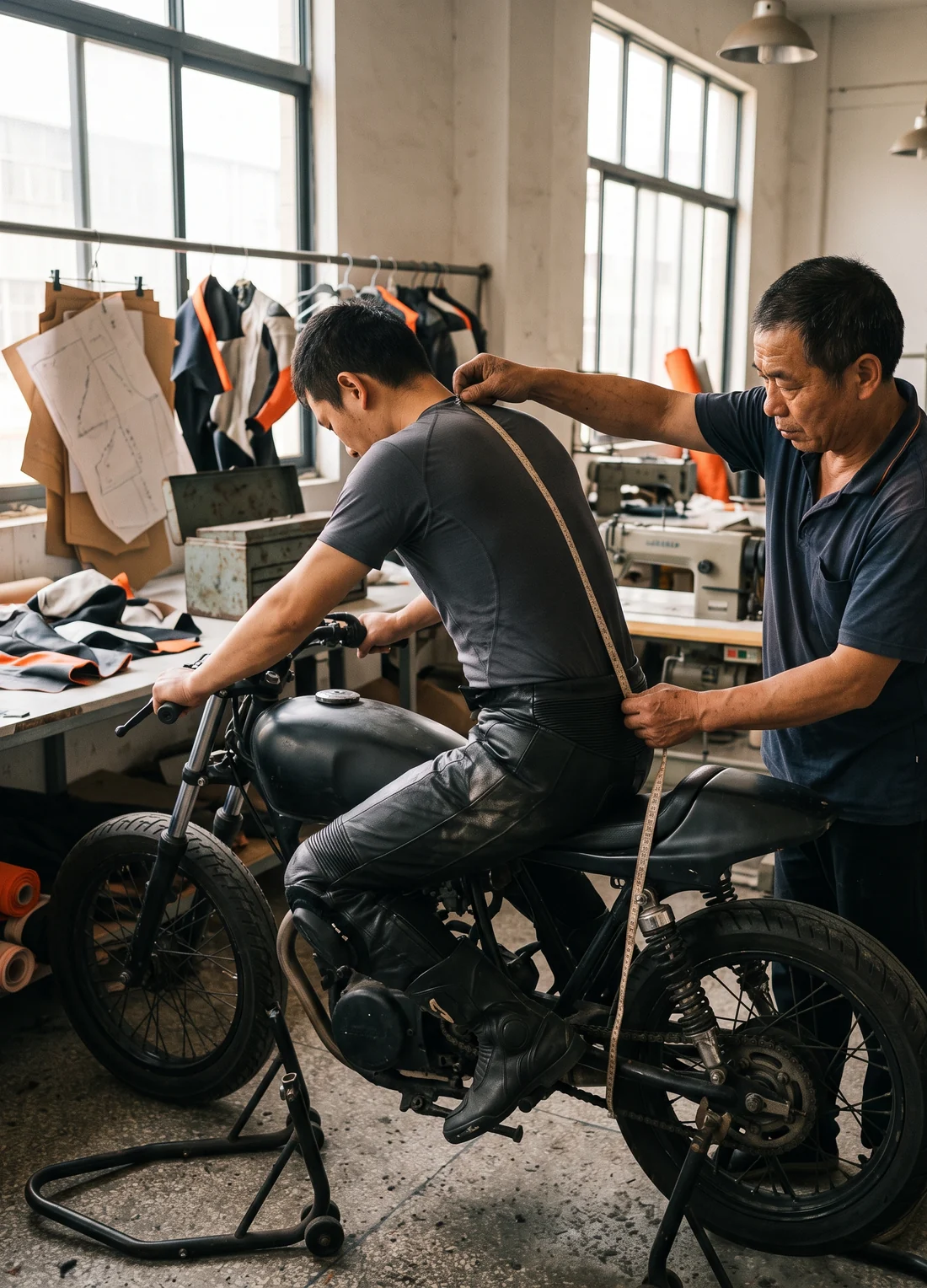
How to check itIf nobody asks you for an arm measurement with the arm bent, the suit is being made from a size chart.
Back length being measured with the rider in the riding position on a bike
Measured in position
Lead times

Lead times, and why leather takes longer than print

Nothing in a leather suit can be rushed without showing: a hide gauged quickly is a hide not gauged.
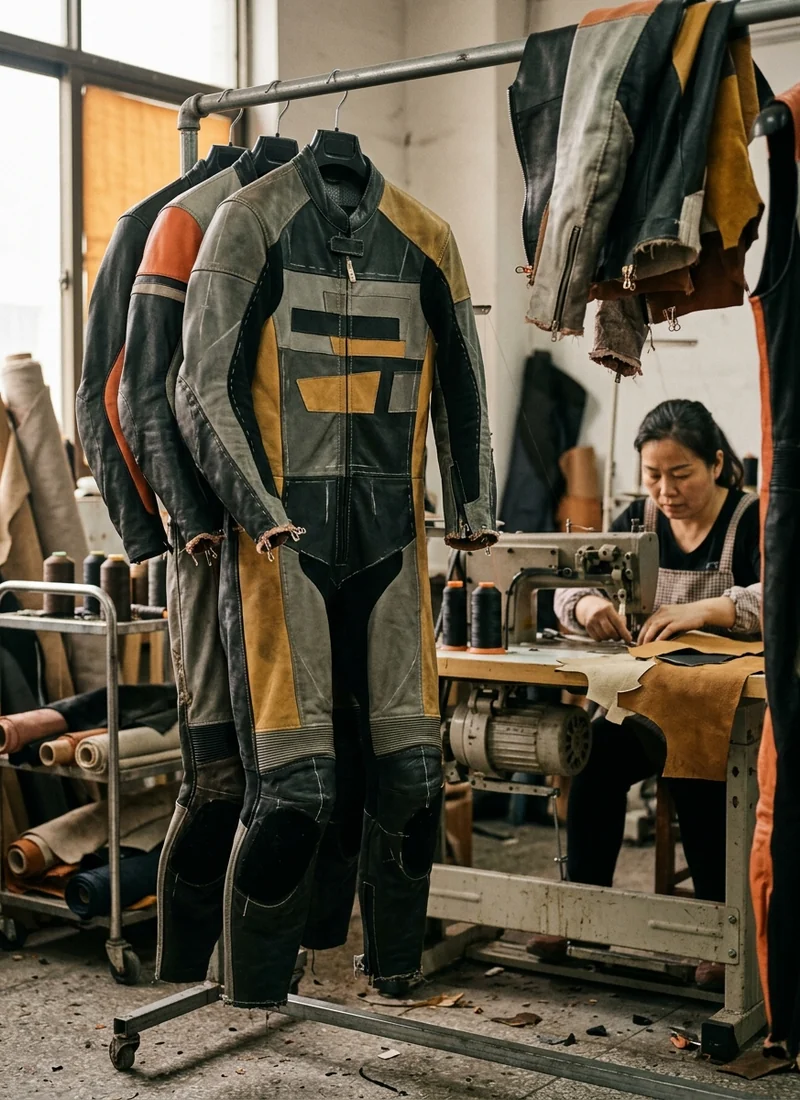
SamplingHide selection and gauging, pattern adjustment, cutting, assembly, fitting and correction
15–20days
Bulk after sample approvalScheduled backwards from your date
25–35days
One-off made to measureA single suit runs the same route as a batch, because the route is what makes it fit
From 1piece
Team and club ordersSame block, each suit cut to its own measurement set
From 10bulk
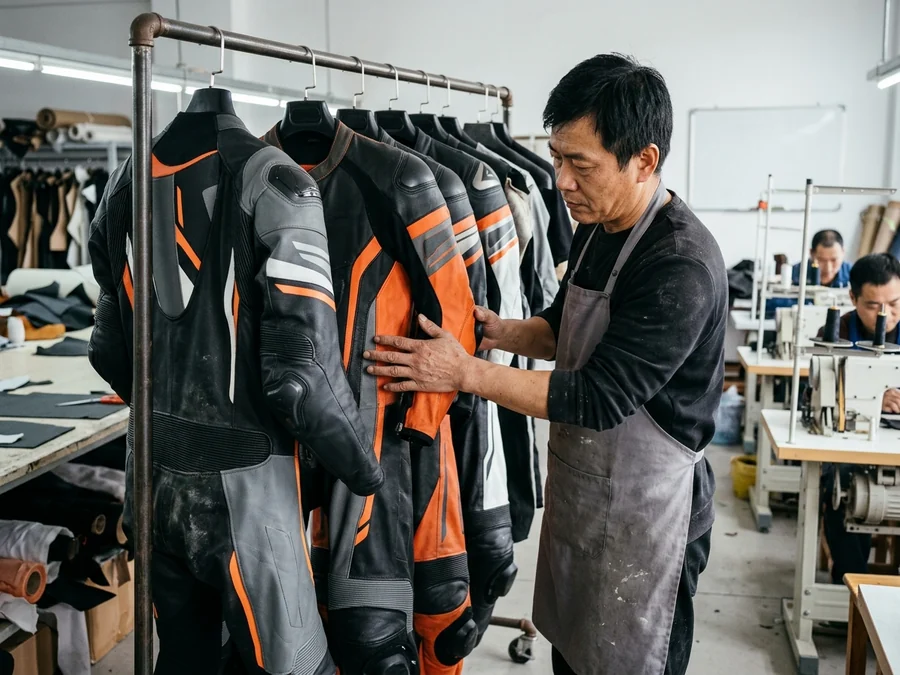
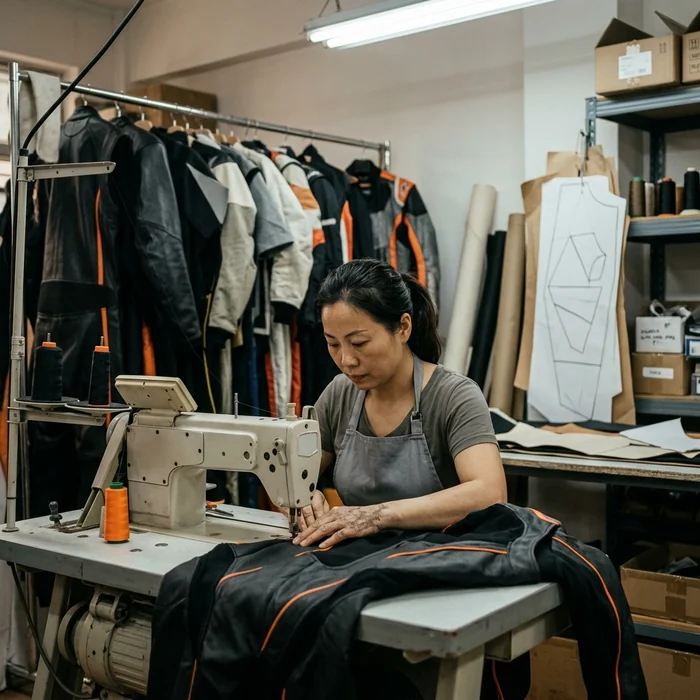
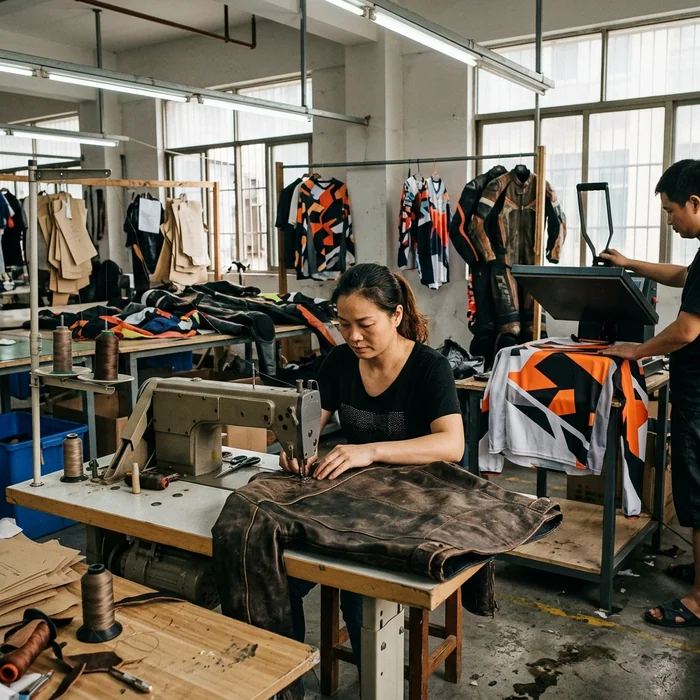
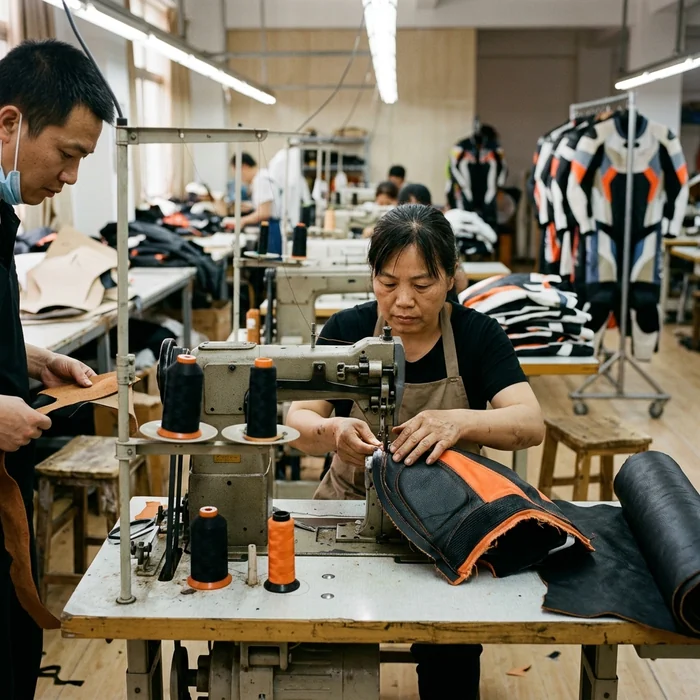
Leather suits in progress on the workshop rack
Slow where it has to be
Why the days are where they areA seam sewn fast in the slide zone is the seam that opens. The time goes into the two steps that cannot be redone: gauging the hide, and closing the seams that will meet the road.
One suit or ten

Send the measurements and what it is for, and we will tell you how it gets built

With the sample

The leather sample pack: suit, hide record and fitting sheet

The suit, the hide record and the fitting notes — so the corrections can be made against something rather than remembered.
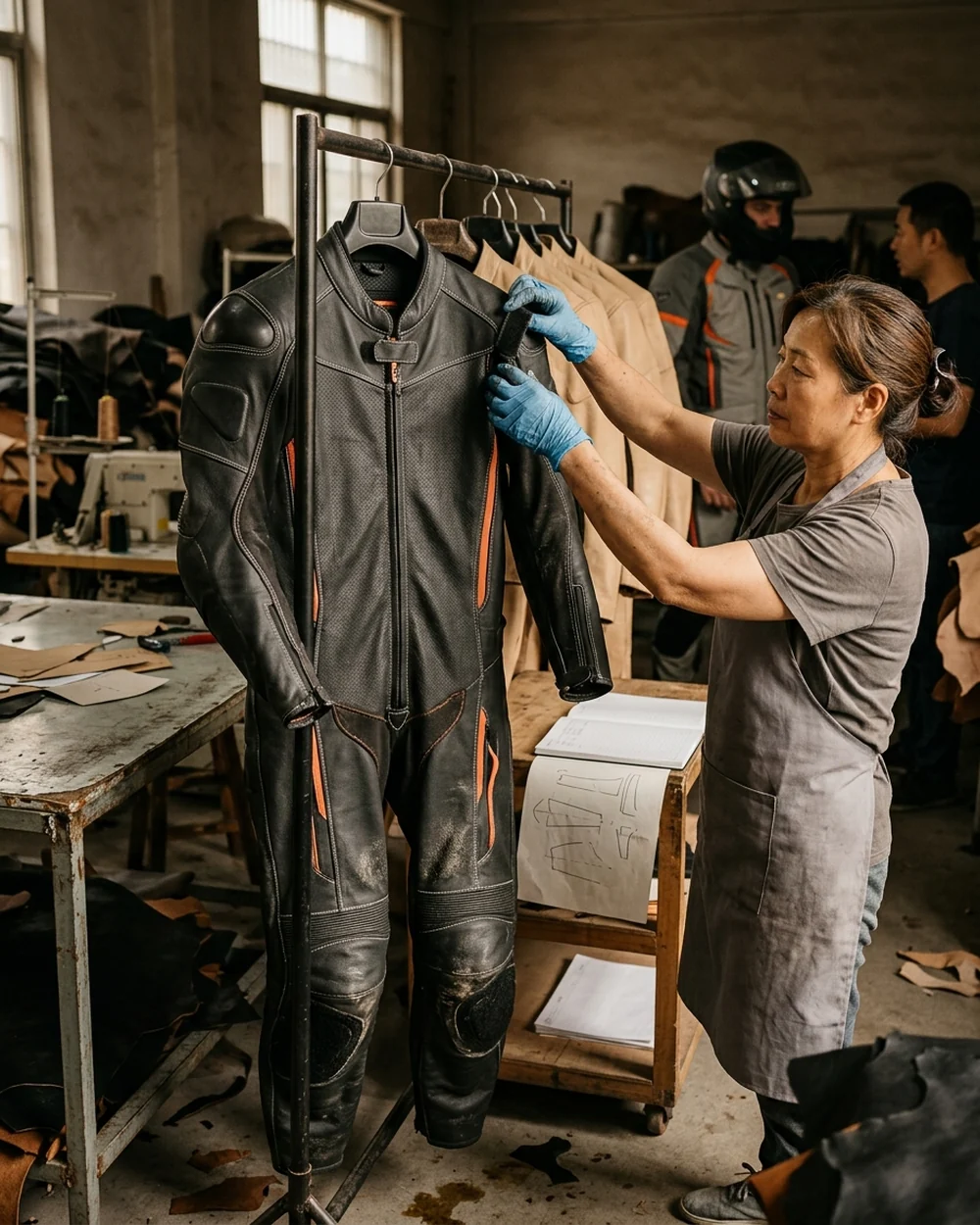
The sample suit with the armor pockets loaded, ready to be fitted
The suit · armor loaded
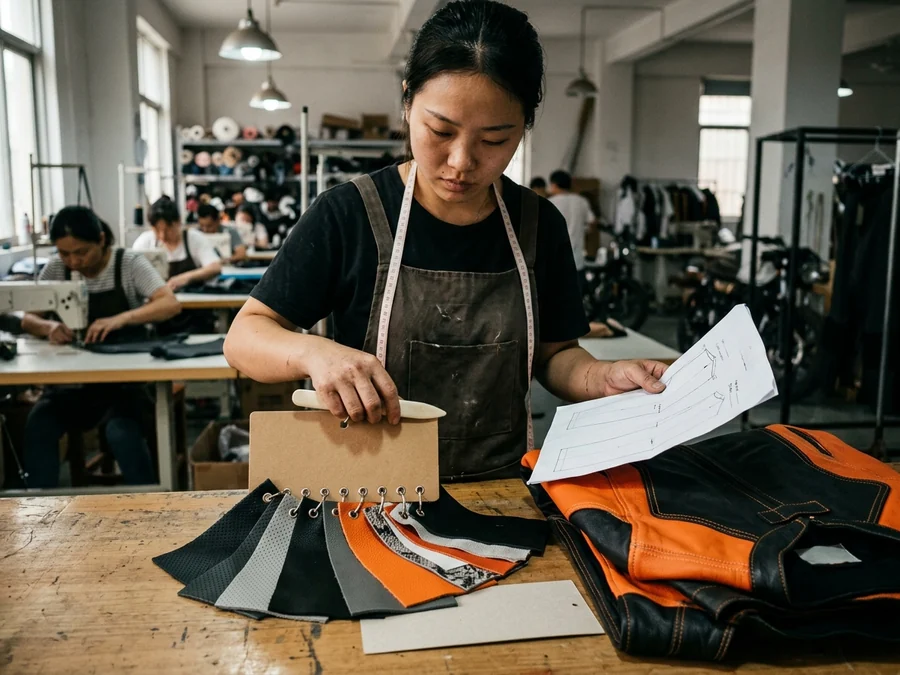
Hide record listing which hides the suit was cut from and what they gauged
Hide record
Fitting sheet ready to be marked up on the bike
Fitting sheet
  • The suit itselfIn your measurement set, with the pockets loaded so you can fit it properly.
  • The hide recordWhich hides it was cut from, and what each of them gauged.
  • The fitting sheetThe points we check, for you to mark up on the bike rather than in a mirror.
  • The pattern noteWhat was adjusted from the block for your measurements, so a second suit matches.
Why the note mattersA second suit for the same rider is cut from the stored measurement set and that note. Without it, the second suit is a new development with the same name.
Changes

Changes to a leather order, and what each costs

In leather, some changes are a correction and some are a new suit — the line between them is the first cut.
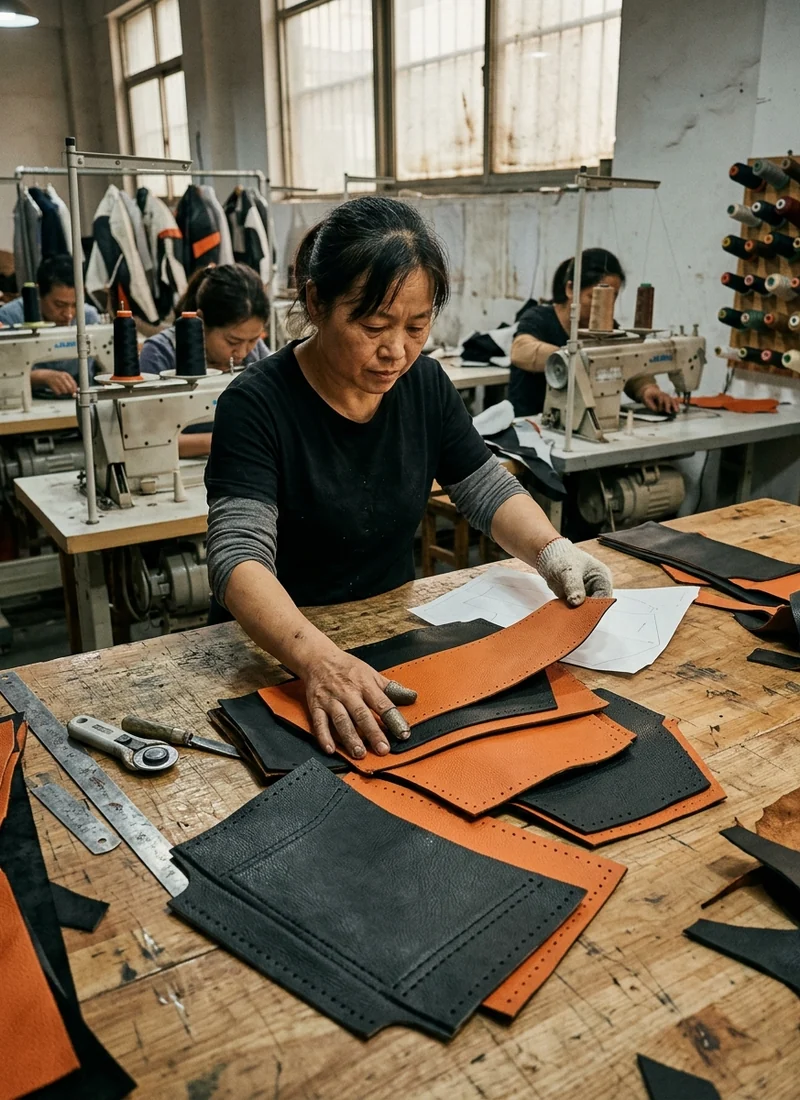
Colour or panel layout change before cuttingNothing has been cut, so nothing is lost
Noneno effect
Measurement correction after fittingPattern corrected; altered or remade depending on which measurement moved
Dependson the measurement
Colour change after cuttingThe panels already exist in the old colour
Re-cutnew panels
Armor changed after fittingPocket re-checked against the new pad
Newif pad size changed
A second suit for the same riderCut from the stored measurement set and pattern note
Noneno new fitting
Adding a team to an existing designSame block, one measurement set per rider
25–35days bulk
Cut leather panels laid out, the point after which changes mean re-cutting
After this, changes mean re-cutting
Six things

Leather suit quote: the six things to send

Send these six and Anna comes back within 24 hours on business days with the construction and the lead time.
  1. What it is for

    Road racing, track days, karting or a club fleet; it decides the block and the construction.
  2. One suit or several

    And whether the several are for one team or several unrelated riders.
  3. The measurement set

    Or tell us you need the measuring guide and who will be taking them.
  4. The armor

    What you intend to fit, so the pockets are built for it.
  5. The design

    Colours, panel layout, badges or names, and anything that has to match printed kit.
  6. The date

    We count back from it.
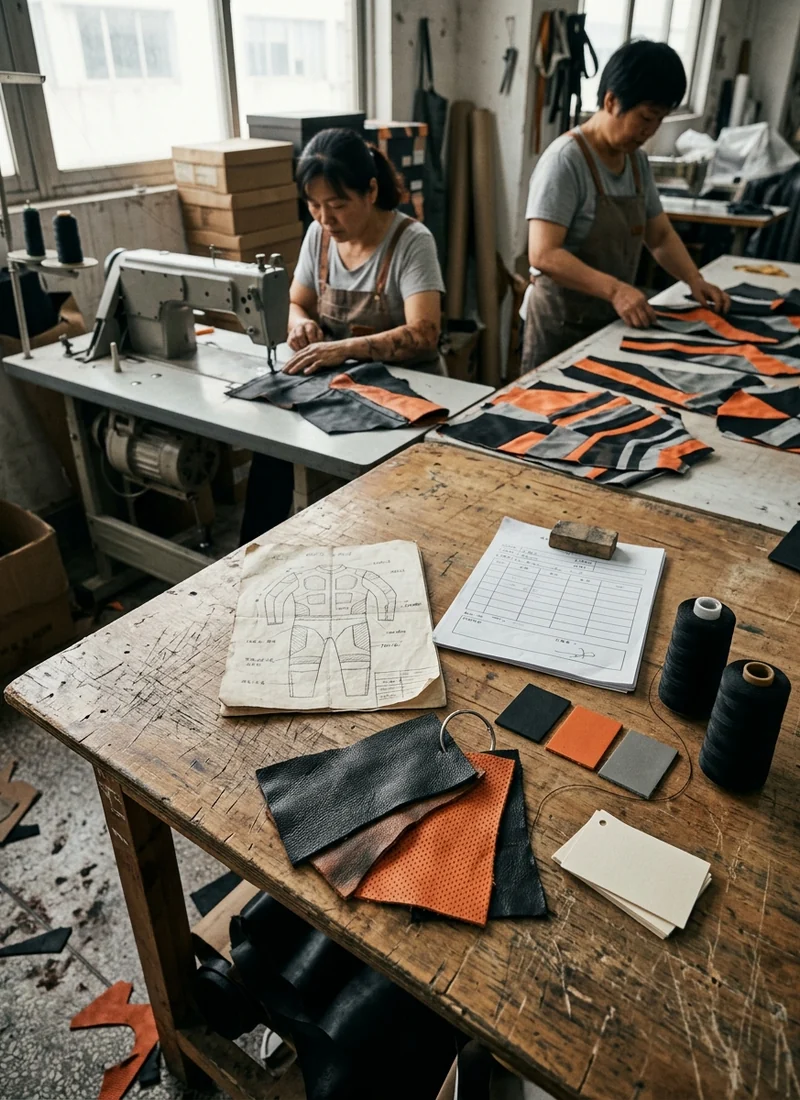
Design sketch, colour references and a measurement sheet ready to send
Six things · one email
Measurements and purpose

Send the measurements and what it is for, and we will tell you how it will be built

Anna replies within 24 hours on business days with the construction, which block it starts from, the lead time and what we need next — including the measuring guide if you need one.

Anna · Sales Manager WhatsApp / phone: +86 177 0272 7677 Email: sales@runmotoapparel.com Mon–Sat 9:00–18:00 (GMT+8)